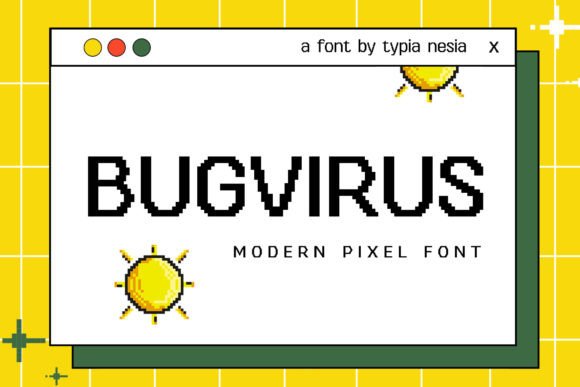
Bringing Retro Charm to Life with the Bugvirus Pixel Font
Remember the feeling of blowing dust off a cartridge, hearing that distinct startup chime, and watching blocky characters spring to life on a CRT screen? For many of us, that era wasn't just about gaming; it was a foundational moment in digital culture. Today, as we navigate a world of ultra-high-definition displays and sleek, minimalist interfaces, there is a growing hunger for something that feels more tactile and human. This is where Bugvirus steps in. It isn't just a typeface; it is a bridge back to the golden age of 8-bit and 16-bit aesthetics, designed specifically for creators who want to inject genuine nostalgia into their modern projects.
At its core, Bugvirus is a pixel-style font that captures the essence of retro gaming and early digital technology. Unlike standard fonts that try to mimic pixels but end up looking blurry or inconsistent on high-resolution screens, this font is engineered to deliver an authentic pixelated experience. Every character is constructed with the precision of old-school sprite art, ensuring that whether you are designing a mobile app icon or a large-format poster, the edges remain crisp and the vibe remains intact. It evokes memories of classic video games without feeling like a cheap imitation.
Why Designers and Marketers Are Turning to Pixel Aesthetics
The resurgence of retro design isn't accidental. In a marketplace saturated with clean sans-serifs and corporate geometrics, standing out often means going against the grain. Entrepreneurs and small business owners are finding that using a font like Bugvirus can instantly communicate personality. It signals that a brand doesn't take itself too seriously, that it values fun, and that it understands internet culture.
Consider a local coffee shop launching a new "Game Night" event. Using a standard font on their flyer might get the job done, but it won't create excitement. However, swapping the headline to Bugvirus immediately sets the tone. It tells the customer, "Come ready to play." Similarly, tech startups focusing on developer tools or coding education often use pixel fonts to appeal to engineers who grew up hacking on Commodores and Nintendos. It creates an instant sense of community and shared history.
For marketers, the utility lies in emotional connection. When an audience sees Bugvirus, they don't just read text; they feel a sense of familiarity. This is particularly effective in social media campaigns where stopping the scroll is the primary goal. A tweet or an Instagram story featuring pixelated typography stands out amidst the polished, airbrushed content that dominates feeds today.
Real-World Applications Across Industries
The versatility of Bugvirus extends far beyond simple headlines. Its application varies significantly depending on the user's goals and the medium they are working in. Here is how different professionals are leveraging this tool:
- Indie Game Developers: This is the most obvious fit. Developers creating platformers, RPGs, or puzzle games use Bugvirus for in-game dialogue boxes, menu screens, and title logos. It ensures the UI matches the art style, creating a cohesive immersive experience.
- Digital Content Creators: YouTubers and Twitch streamers often use pixel fonts for their overlays, thumbnails, and channel art. It helps establish a personal brand identity that feels energetic and nostalgic, appealing to the massive gaming demographic.
- Educators and EdTech: Teachers creating materials for computer science classes or history lessons about the evolution of technology find Bugvirus invaluable. It makes learning about binary code or early computing feel less abstract and more engaging for students.
- Fashion and Merchandise: Small business owners selling t-shirts, stickers, and tote bags often look for designs that resonate with millennial and Gen Z buyers. Bugvirus allows them to create slogans and graphics that feel like vintage arcade cabinet art, adding perceived value to physical products.
- Web Designers: While not suitable for long-form body text due to readability constraints at small sizes, Bugvirus is perfect for navigation bars, call-to-action buttons, and footer elements on portfolio sites or creative agency landing pages.
Practical Considerations Before You Download
While the charm of Bugvirus is undeniable, practical usage requires a bit of strategy. Just because a font looks cool doesn't mean it fits every scenario. The most important factor to consider is legibility. Pixel fonts rely on the grid structure of the screen. If you scale them down too much, the individual blocks can merge, making the text unreadable. Conversely, if you stretch them disproportionately, the pixels become rectangular and distorted, breaking the illusion.
When integrating Bugvirus into a project, think about the hierarchy of information. Use it for impact—headlines, short labels, and logos—rather than paragraphs of text. Imagine trying to read a terms-of-service agreement written in 8-bit style; it would be exhausting for the user. Instead, pair Bugvirus with a clean, highly readable sans-serif font for the body copy. This contrast creates a professional look where the retro element acts as an accent rather than a distraction.
Another consideration is the context of your brand. If you are a law firm or a medical provider, the playful nature of Bugvirus might undermine the trust and seriousness you need to convey. However, for creative agencies, toy stores, music festivals, or tech blogs, it reinforces a culture of innovation and fun. Always ask yourself: "Does this font support the message I am trying to send?"
Maximizing the Nostalgic Effect
To get the most out of Bugvirus, pay attention to color palettes. Pixel art traditionally relies on limited color schemes. Pairing the font with neon greens, electric blues, or vibrant magentas against dark backgrounds can enhance the retro gaming feel. Avoid overly complex gradients behind the text, as they can clash with the hard edges of the pixels.
Furthermore, consider the medium. Bugvirus shines in digital environments where the pixel grid aligns perfectly with the screen resolution. If you are printing, ensure your printer can handle the sharp details of the pixel edges without blurring them. High-quality vector exports are essential here to maintain that crisp look even on physical merchandise.
Ultimately, Bugvirus is more than a stylistic choice; it is a storytelling tool. It allows creators to tap into a collective memory of simpler digital times. Whether you are a freelancer pitching a new brand identity, a hobbyist making a zine, or a developer launching the next big indie hit, this font offers a unique way to connect with your audience. By understanding where and how to apply it, you can transform a standard design project into an experience that resonates on an emotional level, proving that sometimes, looking backward is the best way to move forward.